

Wiki is in the process of importing stuff
Please be patient. Additionally to upload stuff, please use
main wiki temporally.

Chiangism, also called the Chiang Kai-shek Thought and commonly known as Conservative Tridemism or Right Kuomintangism, is the ideology of Chiang Kai-shek, the former president of the  Republic of China (1911-1949) and the Republic of China exiled government in Taiwan (1949-). Chiangism is an
  Authoritarian Unity and
  Culturally Center-Right ideology that was highly influential in China before the communist takeover and Taiwan, until the sweeping democratization of Taiwan in the 1990s.
History
[edit]The right KMT was officially formed after the cleansing against communists and communist sympathizers in the KMT in 1927 known as the ‘Shanghai Massacre’, the start of the so-called ‘white terror’. In addition, the white terror's primary targets were those who advocated the  Soviet model of government, such as
  Wang Ming and
  Mao Tse-tung in the CCP, as well as
  left-wing Kuomintang party members. Shanghai Massacre and subsequent anti-communist massacres across China killed 40k to 300k communist affiliated political dissidents, and marked the start of the Chinese Civil War.
The most prominent figures of Right KMT were  Chiang Kai-shek,
  Hu Hanmin and his Western Hills Group (before his imprisonment), and
  Chiang Ching-kuo. The right KMT took a more
  anti-communist,
  socially conservative and authoritarian party line than the original KMT, but it continued Sun’s Georgist economic policies in Taiwan after it was defeated by the
  communists in mainland China. It is also very anti-Japanese and Chinese nationalist in general.
Chiang’s government continued Northern Expedition after splitting with the communists in 1925 and unified China under the Nationalist Government in 1928 (Only nominally). A period of prosperity and modernization was experienced in China during the Nanking decade with the modernization of infrastructure and a focus on light industries such as the cotton industry, airlines, highways, and factories. China also had increased education, with schools built nationwide under nationalist rule. However, the achievement was somewhat limited as the nationalists only had limited control over the country, with warlords having de facto control over most parts of China and a raging communist rebellion. Periodical famines continued throughout China. The political tutelage stage was scheduled to end in 1937 with Sun’s ideal of constitutional democracy to be implemented. Still, the process was delayed till the 1940s due to the Sino-Japanese War.
Reactionary practices such as foot-binding, polygamy, and child marriage were strictly prohibited and enforced by the Nationalist government for social progress. But the nationalists under Chiang were worried that westernization could impede and diminish the positive aspects of Chinese traditions, such as gender roles, family values, morals, and ethics. Therefore, the nationalist regime started a  New Life Movement that promotes Confucianism and traditional Chinese values. Many scholars have described this movement as
  Neo-Confucianist. Chiang also turned further nationalistic and grew interested in the government systems of
  Nazi Germany,
  Fascist Italy, and
  Kemalist Turkey. The
  Chinese Blue Shirt Society was founded in 1932 by Dai Li as an experiment that modeled the Black Shirts paramilitary wing of the Italian Fascist Party with a slogan of ‘One Doctrine, One Party, and One Leader’ with strong anti-Japanese and anti-western/American sentiments. The organization was disbanded in 1938 as Chiang moved away from fascist influence due to the deterioration of the relationship between China and the Axis due to Japanese invasion of China.
The Japanese invasion was reliving for the communists strategically as the second United Front was formed between the nationalists and the communists. During the Second Sino-Japanese War, major battles were fought between the nationalists and the Japanese, with 3.8 million-10 million Chinese soldiers perishing or injured to defend China from  Japan’s genocidal fascist regime. The Japanese side also suffered heavy losses, with 2.2 million casualties from the Japanese invasion forces and 1 million from the collaborators. The international community only diplomatically condemned Japan and gave China minimum financial support until the US entered the war in 1941; the nationalists caused the Yellow River Flooding to stop the Japanese military advance. This flooding caused the deaths of 400k to 900k civilians. Combined with food shortages, the Yellow River Flood caused the Henan Famine.
China’s post-war partial transition towards democracy in 1947 followed the global wave of democratic changes in previously non-aligned authoritarian countries such as Turkey, Brazil, and Greece, further shifting the KMT’s ideology from fascist-alike fervent nationalism back to  Sun’s democratic socialism (at least economically) with the crackdown of capitalists in Shanghai, price controls, monetary reforms, and an expansion of workers rights. However, the nationalists failed to control hyperinflation due to war shortages, corruption and the lack of foreign economic support, which caused the economic collapse of the nationalist-ruled regions.
After the KMT retreated to Taiwan, its ideology shifted to  Pro-American authoritarian capitalism, along with many dictatorial regimes such as
  Francoist Spain,
  Ilminist Korea, and
  Kenan Evren’s Turkey. However, Sun’s principle of
  Georgism was still preserved by the nationalists. Land reform was successfully implemented in Taiwan. Along with state planning policies of
  technocrats such as Yen Chia-kan, and
  Chiang Ching-Kuo's Soviet-inspired planning policies, the Gini index of Taiwan was brought down from 0.52 in the Japanese colonial era to just 0.28 during the nationalist rule, and the lower 40% income group doubled their income share to 22% of total income with the income share of the upper 20% shrunk from 61% to 39%. Taiwan also experienced a period of prosperity and rapid growth that topped in Asian four tigers, albeit with the most egalitarian developmental model due to
  the socialist ideology of Kuomintang.
After retreating to Taiwan, Chiang learned from his mistakes and failures in the mainland and blamed them for failing to pursue Sun Yat-sen’s ideals of Tridemism and welfarism. Chiang’s land reform more than doubled the land ownership of Taiwanese farmers. It removed the rent burdens on them, with former land owners using the government compensation to become the new capitalist class. He promoted a mixed economy of state and private ownership with economic planning. Chiang also promoted a 9-years free education and the importance of science in Taiwanese education and values. These measures generated great success with consistent and strong growth and the stabilization of inflation.[7]
Before the fall of mainland China into communist hands, the Nationalists drafted a new constitution with independent democrats and opposition parties such as  CDSP (China Democratic Socialist Party) and
  Youth China Party. A comprehensive constitutional draft of civil rights, minority rights, and women’s rights based on Sun’s Five-Power separation proposal was established.
Most of the provisions were, however, suspended in Taiwan with martial law declared as the nationalists saw Taiwan as a temporary base to retake mainland China. The nationalists became more  brutal and dictatorial in Taiwan than in mainland China. The nationalist regime increased press censorship and control over civil activities to counter communist infiltration,
  and the police state was also expanded. A notorious incident was the 228 Incident with atrocities committed by the nationalist government, although the
  Fujian Governor Chen Yi responsible for this incident was later executed for committing the atrocities after the nationalists retreated to Taiwan. This incident caused the deaths of 18k-28k civilians and militants who were either massacred or executed by the KMT regime. However, some provisions of the constitution, such as local elections, women’s rights, and parliamentary quotas, were upheld by the nationalist regime despite the martial law in place. Throughout the history of the white terror, 30k-40k were executed for their alleged ties to the Chinese communists or separatism, at least 140k were imprisoned, with many brutally tortured by the Chiangist regime.
After the death of Chiang Kai-shek in Taiwan, the Chinese nationalist KMT regime began to relax its political restrictions and to improve its civil rights and freedoms under the reforms of Chiang Ching-kuo. In 1986, the  Democratic Progressive Party was formed as a real opposition party, which Chiang Ching-kuo did not try to shut down.
After the democratization of Taiwan, it began to slowly drift away from the Chiangist economic policy to embrace a more free market system, as part of the  economic globalization process under the context of
  Neoliberalism.[8]
Beliefs
[edit]Chiangism is a conservative interpretation of Tridemism that is more socially conservative, authoritarian, Confucianist and anti-communist than the original Tridemism. It is also more authoritarian and anti-Japanese than the original Tridemism. However, after WW2, the relationship between  Japan and Chiang’s Taiwan (after his regime fled to Taiwan in the late 1940s) warmed up again due to shared interests, anti-communism, and conservative ideological alignment.
Chiangism was initially highly authoritarian (especially in the Taiwan martial times) until Chiang Ching-kuo reformed the KMT party-state and made it only moderately authoritarian.
Despite being a right-wing authoritarian ideology that suppresses dissents with an iron fist, Chiangism always calls itself the bastion of ‘Free China’ and a champion against communism totalitarianism.
After the government of the Republic of China moved to Taiwan, Chiang Kai-shek's economic policy turned towards to  Economic Liberalism, he used Sho-Chieh Tsiang and other liberal economists to promote economic liberalization reforms in Taiwan.
However, Taylor has noted that the developmental model of Chiangism in Taiwan still had elements of socialism, and the Gini index of Taiwan was around 0.28 by the 1970s, lower than the relatively equal  West Germany. Taiwan was one of the most equal countries in the pro-western bloc. The lower 40% income group doubled their income share to 22% of total income, with the upper 20% shrinking from 61% to 39%, compared to the Japanese rule. The Chiangist economic model can be seen as a form of
  Dirigisme or
  State Capitalism, with the
  state playing a crucial role in directing the
  market economy. Small businesses and state-owned enterprises flourished under this economic model in Taiwan, but it didn’t see the emergence of corporate monopolies, unlike most other major capitalist countries.
After the democratization of Taiwan, it began to slowly drift away from the Chiangist economic policy to embrace a more free market system, as part of the economic globalization process under the context of Neoliberalism.[9]
Irredentism
[edit]In the 1950's, Chiang Kai-shek launched a large-scale, yet unsuccessful plan to retake  mainland China and
  Mongolia after facing defeat at the Civil War and relocation to Taiwan, by the campaign name "Fight Communism, Resist Russia" (反共抗俄). He also attempted to reclaim lost areas occupied by Russia (Soviet Union) throughout history, which included Haishenwai (海參崴;Present-day Vladivostok), Khabarovsk, and Kazakhstan, totaling to approximately 160 times the size of Taiwan island[10]. Initially this plan will also include a full-scale invasion of the Soviet Union if North Korea was defeated in the Korean War and the Nationalists regain control of China[11], taking most parts of Russia as follows:
- Taiping Province (太平省) which compromises of Vladivostok, Amur, Sakha, Khabarovsk, parts of Sakhalin (Kuril Islands will be returned to Japan) and Magadan, where Taiping City (Approx. at present-day Khabarovsk Krai) as the provincial capital;
- Chunghsing Province (中興省) which compromises of Eastern Siberia, where Siberia (Approx. at Krasnoyarsk Krai) as the provincial capital;
- Yongning Province (永寧省) which compromises of Western Siberia and Ural, where Novosibirsk as the provincial capital;
- Yongan Province (永安省) which compromises of Kazakhstan, Uzbekistan, Tajikistan, Turkmenistan and Kyrgyzstan, where Yongan City (Approx. at Qyzylorda, Kazakhstan) as the provincial capital;
- The rest of the Soviet territories, which compromises of the remaining territories of Russia, Ukraine, Belarus, Georgia, Estonia, Latvia and Lithuania will be under the administration of the United Nations after a series of hydrogen and atomic bombs were dropped into Russia.
Personality and Behaviors
[edit]Chiangism remains highly controversial both internationally and in the cross-straits. Supporters praise his efforts in the Nanjing Decade, drafting the  Constitution of the Republic of China with broad civil rights provisions, resisting
  Japanese imperialists, Taiwanese land reform and building Taiwan that made it an Asian Tiger. He was also credited for his improvements of women’s rights, technologies and education, as well as his rural reconstruction movement. Chiang's supporters also credit his resistance of Soviet imperialists and his firm opposition to the communist take over of China.
Conversely, Chiang's detractors denounce him as an incompetent tyrant, and often accuse him of being a  quasi-fascist dictator who violently suppressed and massacred dissents with white terror and flooded the Yellow River flood that killing hundreds of thousands and subsequently caused the Henan Famine (even though it was done to resist Japan’s colonization and genocide against China). Detractors also criticize his government's
  Kleptocracy (even if he did not involve in corruption personally) and the massacre of Taiwanese dissidents during the 228 Massacre.
How to Draw
[edit]Chiangism's flag was based on the Flag of the National Revolution Army, currently also the flag of the Republic of China Army which was under his command.
- Draw a ball.
- Color the ball with red.
- Draw the flag of Kuomintang (refer Tridemism) on the middle.
- Draw Chiang's peak cap or optionally, draw the medal of the Order of the Blue Sky and the White Sun on bottom left of the ball.
- Add the eyes, and you're done!
Relationships
[edit]Patriots
[edit] Tridemism - My dad! 國父孫中山先生萬歲! (Long live the Founding Father Mr. Sun Yat-sen!)
 Just ignore the fact that I murdered and imprisoned many of Sun's loyal followers, including Hu Hanmin. Triequism - I sheltered Kim Gu and Korean nationalists to establish the Korean Provisional Government in Shanghai as an umbrella against Japanese imperialism.
 Ilminism - My Korean brother who shares the same goal of mine.
 But why did you murder Kim Gu?? Stratocracy - 軍政 (Stratocracy), 訓政 (Political Tutelage under KMT’s one-party state), 憲政 (Constitutional democracy), a unified China under Tridemism.
 Conservative Feminism - The First Lady Soong Mei-ling is a conservative Tridemist feminist who supports strong-willed women and traditional gender roles. Also, I introduced a gender quota in the constitution of the Republic of China and Taiwan was one of the most feminist countries in Asia under my rule. [12]
 Irredentism - RECLAIM MAINLAND!!!! ELIMINATE ZHU MAO!!!!!!
- File:AuthCon.png Authoritarian Conservatism - White terror go brrrr.
 Social Conservatism - Ethics and morals are essential for the health of China as a nation.
 Kemalism - You are a great inspiration to the nations of the free world. I even sent a photo of mine to you.[13]
 Scientocracy - Science is needed to build a technologically and educationally advanced China.
 Confucianism - Traditional Chinese meritocracy is far better than western ideologies.


Temporary “Allies”
[edit] Hu Hanmin Thought - You were useful for me at first, but later you betrayed me.
 Liberalism - Only File:Hushih2.png Hu Shih can have free speech and free publications in Free China.
 Chinese Blueshirtism - You were once useful for me, but uh, I now hate fascism and I don't need you anymore as I started a self-defense war against the Axis and Fascist Japan.
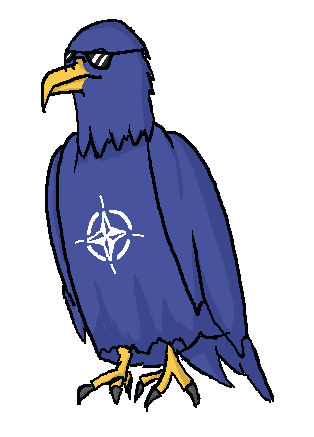 Neoconservatism - We are supposed to be allies, right? Why didn’t you help me during the civil war and why did you try to coup me??? Thanks for your aid for me to build Taiwan though
 Stalinism - We have a very complicated relationship like the above.......
 Japanese Liberal Democracy - We have a relatively good relationship after WW2, but why did you give
  traitors a shelter?
 New Deal Liberalism - Thanks for your aid and your efforts against the Japs, but why didn’t you like me and even tried to assassinate me?
 Liberal Tridemism - Good job continuing my legacy to the future and continues to be anti-communist. Though too moderate and liberal but I like Xin Haonian. Lei Chen was a nation traitor though.
 Nazism - How can I be your ally when you're an ally of that
  Japanese devil? I’ll declare war on you too! Thanks for the equipment and advisors. Chiang Wei-kuo was also serving as an officer during his military service in Germany during the Sino-German Cooperation.
 Francoism - You are way too religious and traditionalism and monarchism are bad. However, we are otherwise similar on many aspects in terms of culture and anti-communism. But why did you recognize
  that communist scum over me?
 Marxism - Most people who hate me or love me might not believe it: I used to be a staunch Marxist. That being said, even though anti-capitalism and revolutionary anti-imperialism are based af, his anti-nationalism, anti-conservatism, and cultural views are just terrible. Confucian Chinese traditions have better socialist roots than western ideals like Marxism.
 Manchuphobia - Well, Manchurians are one of chinese members now.
 I commanded 100 soilders to attack Hangzhou Manchurian Castle and won 10,000 eight banners.


.png)


NATIONAL TRAITORS
[edit]- Maoism - Commie psycho scums, prepare to be eliminated! I bore the all the fighting against the Japs while you just hid and grew your army!
 Dengism - Three NOes: no contact, no negotiation and no compromise.
- Showa Statism - Japanese genocidal rapist scums!! Never forget Nanking Massacre!!!
- Taiwanese Separatism - Eat my bullets you self-hating Han Chinese
Taiwaneseseparatist traitors!  Revisionary Tridemism - Revisionary scums! What the fuck did you do to my party?
- File:ChiangWeishui.png Chiang Wei-shui Thought - I used you against him before, but now I need you no more. Get banned by my white terror.
 Wang Jingwei Thought - FUCKING TRAITOR WHO BETRAYED THE NATIONAL REVOLUTION AND CHINA!!!!
 Separatism - NO SEPARATISM, MONGOLIA IS INALIENABLE PART OF CHINA FUCK CCP FOR SELLING YOU!!!
 Even though the Soviet imperialists forced me to give independence to Mongolia but then again I retracted my recognization after I retreated to Taiwan because the Soviets didn’t honor the treaty. Anti-Authoritarianism - HA HA Shanghai Massacre, February 28, and white terror go brrrrr!
 Imperialism - ‘If imperialism is not banished from the country, China will perish as a nation. If China does not perish, then imperialism cannot remain.’
- File:HarryTruman.png Truman Liberalism - I hate you because your illusions about the CCP caused us to lose all of China!


Further Information
[edit]Notes
[edit]Page Template:Reflist/styles.css has no content.
- ↑ Chiang Kai-shek rarely remained steadfastly committed to an ideological stance or factional policy. He could easily adapt to any faction when it was politically advantageous, without becoming a genuine member of that faction.
Citations
[edit]- ↑ Chiang's regime was very corrupt, but not him personally
- ↑ "Chiang Kai Shek: ‘‘We must use every inch of our blood...’’" Quotepark.
- ↑ Initially Chiang Kai-Shek was a Marxist who researched several works of Karl Marx and held left-leaning views, until he began to be skeptical towards the KMT-CCP co-operation after the Canton Coup.
- ↑ Chiang Kai-shek attempted to implement Georgist principles as dictator, despite having to cooperate with the landlord class in response to the instability during his reign. In 1933 he attempted to gradually implement land reform through the Chinese Institute of Land Economics, which he argued was a continuation of Sun Yat-sen's Georgism. He attempted to collect land rents and also ensure the Chinese had "equal right" to the land.
- ↑ https://en.m.wikipedia.org/wiki/Three_Noes#:~:text=The%20Three%2DNoes%20Policy%20(Chinese,ROC%20(see%20Three%20Links).
- ↑ https://journals.open.tudelft.nl/iphs/article/download/2722/2933/7660 Chiang Ching-kuo was deeply influenced by the economic ideas of the USSR due to his Soviet education despite being a staunch anti-communist
- ↑ [1], CUHK.hk.
- ↑ [2], GHK.tv.
- ↑ http://ghk.nctu.edu.tw/word/3-2-1%E9%BB%83%E6%87%89%E8%B2%B40.pdf
- ↑ https://m.xuite.net/blog/yeh.zi59/twblog/128235258
- ↑ https://pttstudy.com/warfare/M.1595853574.A.E3A.html
- ↑ http://www2.igs.ocha.ac.jp/wp-content/uploads/2019/05/2.pdf
- ↑ https://dergipark.org.tr/tr/download/article-file/653183
Navigation
[edit]


US.png)


.png)


.png)


.png)

.png)


.png)


.png)


.png)


.png)


.png)


.png)


- Authoritarian Unity
- Authoritarian Right
- Culturally Center-Right
- Conservatives
- Nationalists
- Third Position
- Capitalists
- State Capitalists
- Feminists
- Centrists
- Authoritarian Left
- Democratic
- Pages with TemplateStyles errors
- Ideologies
- IRL ideologies
- Chinese Ideologies
- Cultural Center
- Culturally Right
- Irredentist
- Tridemist
- Georgists
- Anti-Colonial
- Anti-Communists
- Asian Ideologies
- Authoritarians
- Confucians
- Criminals
- Eponymous
- Homophobic
- IRL Ideologies
- Male Characters
- Militarist
- Patriots
- Quasi-Fascists
- Quasi-Socialists
- Regional Ideologies
- Regional ideologies
- Serious
- Traditionalists
- Unironic